Who Are the Top Plastic Food Container Manufacturers in China?

Time:2026-11-09 Author:Amelia
0%

Choosing a reliable Plastic Food Container manufacturer in China takes more than comparing unit prices. Buyers should examine product range, material options, production capacity, and communication. A supplier may offer bowls, tubs, lids, and meal-prep boxes, yet the details vary. Check wall thickness, lid fit, stackability, and performance with the intended food and temperature. Ask how samples are prepared and whether production specifications can be confirmed in writing.

This guide considers manufacturers through practical purchasing criteria, not unverified rankings. It highlights the questions that help buyers compare suppliers: What quality checks are performed? Can the factory provide clear product specifications and relevant documentation? How are custom colors, printing, and packaging handled? A sample lid that seals neatly on a workbench is useful, but it does not prove consistent results across a full production run. Small details matter. So does follow-up.

Company profiles and product claims should be checked directly, since capabilities and available certifications can change. Buyers should confirm requirements for their own markets and applications rather than relying on a supplier’s general assurances. There is no perfect checklist. Even a careful review can miss a production issue, which is why sample evaluation and clear communication remain important. The sections ahead offer a grounded starting point for identifying Chinese manufacturers that may fit different product needs, order sizes, and service expectations.
Who Are the Top Plastic Food Container Manufacturers in China?

How China’s Plastic Food Container Manufacturing Industry Is Structured

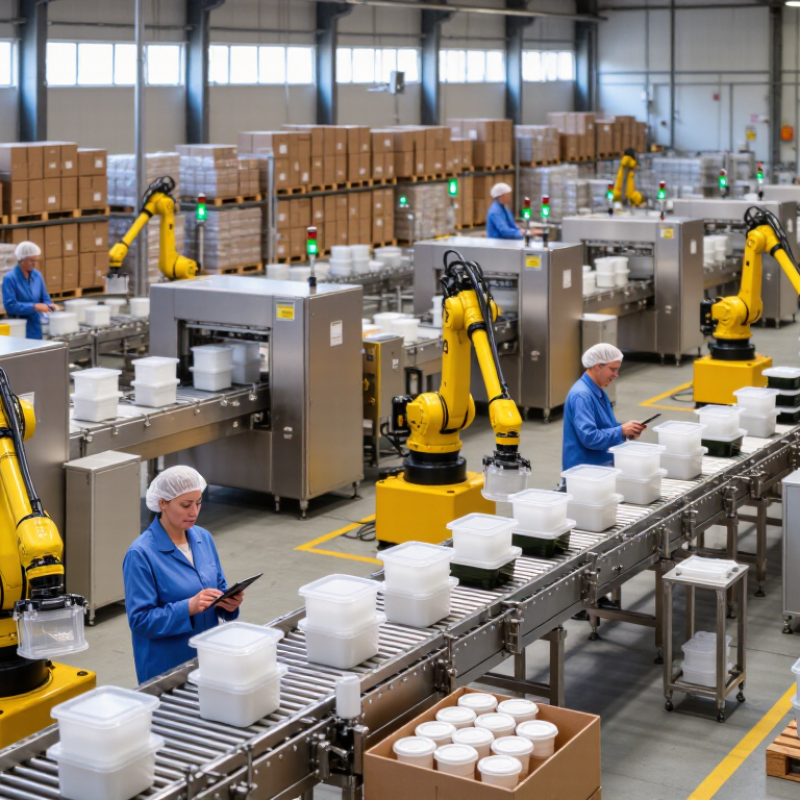
China’s plastic food-container industry is a network, not a single production line. Resin suppliers feed converters, while specialist factories make tubs, trays, lids, and takeaway boxes through injection molding or thermoforming. Some plants print and assemble in-house; others rely on nearby subcontractors. Not every plant does.

The scale is substantial, but broad statistics need careful reading. The National Bureau of Statistics of China reported 74.885 million tonnes of plastic products in 2023. That figure covers many product types, not food containers alone. The OECD’s Global Plastics Outlook identifies packaging as a major plastics-use category worldwide. Together, these reports explain the sector’s industrial base, but they cannot tell buyers how many factories make food-grade containers specifically.

In practice, manufacturers often differ by process, order size, and quality-control capacity. A thermoforming line can turn thin sheet into stackable trays; injection molding suits rigid tubs and fitted lids. Buyers should check material specifications, sample consistency, and traceability records—not just a factory’s equipment list. A polished sample is reassuring, but it does not prove every production batch will match. I would treat that gap as a real weakness in supplier evaluation.

Criteria for Identifying Leading Manufacturers

A leading plastic food container manufacturer should make its materials and production controls easy to verify. Ask for current food-contact test reports relevant to your destination market, plus clear records linking resin batches to finished products. Do not rely on a certificate image alone. Check its scope, date, and issuing laboratory. Details matter. A factory visit or independent audit can show whether staff inspect container walls, lids, and seals during production. Request defect records and corrective actions, not just a quality promise.

Production capability matters as much as paperwork. Compare sample dimensions, lid fit, stackability, and resistance to ordinary handling. Ask how the factory controls wall thickness and color consistency across batches. A sample may look excellent under bright showroom lights, yet perform differently after transport. Samples can mislead. Review mold ownership, replacement plans, monthly capacity, and lead times during busy periods. Clear answers are useful; vague assurances deserve follow-up. Communication is also a practical test: confirm who approves specifications, reports delays, and handles rejected batches. No single score proves a supplier is best. A careful comparison of evidence, production checks, and everyday responsiveness gives buyers a more dependable basis for choosing.

Who Are the Top Plastic Food Container Manufacturers in China?

Criteria for identifying leading manufacturers

Use these evidence categories to assess manufacturers: food-contact compliance, migration test reports, quality management, process controls and traceability, production and delivery records, and sustainability documentation. Each bar represents one checklist category; this is an evaluation framework, not company data or a ranking.

Notable Chinese Manufacturers and Their Product Specialties

China’s plastic food-container sector includes large-volume producers and smaller specialists. Some focus on injection-molded polypropylene boxes for meal prep, chilled foods, and reheating. Others make clear PET containers for bakery displays, salads, and takeaway counters. The material and intended use matter more than a broad “food container” label. Ask for resin details, temperature guidance, and sample products.

A supplier specializing in lids may offer snap-fit rims, hinged closures, or compartment trays. These details affect stacking, handling, and leak resistance. Fit matters. A neat catalog can still hide uneven wall thickness or a lid that loosens after repeated use. Check samples with the foods and storage conditions you actually expect; one test is rarely enough.

Some manufacturers also provide custom sizes, colors, and tooling, while others prioritize standard designs and shorter development cycles. Compare minimum order quantities, mold ownership terms, and the consistency of repeat production. Request clear specifications and inspect how containers nest in cartons, not just how they look on a sample table. Not every lid seals. Supplier claims should be checked against physical samples and relevant product documentation.

Materials, Production Capabilities, and Customization Options

Chinese plastic food container manufacturers commonly use PP, PET, and CPET, depending on the container’s intended use. PP is often selected for heat resistance, while PET offers clarity for chilled foods. Material performance also depends on wall thickness, shape, and the specific resin grade. A container’s suitability for reheating should be confirmed through its use instructions and relevant test records.

Production may involve injection molding, thermoforming, sheet extrusion, or several processes working together. Buyers can ask about mold capacity, trimming accuracy, lid fit, and routine dimensional checks. A fast production line is not automatically a consistent one. Request current material documentation, batch traceability, and quality records for the intended market. Details matter.

Customization can cover capacity, compartments, color, printing, lid design, and stackability. Share drawings and usage requirements early, including temperature range and packaging needs. Then review a sample with actual food or a representative load, not just an empty container. Tooling costs and minimum order quantities may affect the final price. A polished sample does not guarantee every production run will match, so confirm how the factory checks repeatability. Small details count.

Quality Standards, Certifications, and International Markets

For buyers comparing plastic food container manufacturers in China, certificates are a starting point, not proof of consistent production. Ask for current ISO 9001 and ISO 22000 certificates, then check their scope, issuing body, and expiry date. Small details matter. A certificate may cover one factory but not another.

Reliable suppliers can provide material declarations, batch traceability, and migration-test reports for the intended food and use conditions. Request results for repeated-use, temperature, and storage scenarios where relevant. For European sales, verify compliance with Regulation (EU) No 10/2011; for the United States, review applicable FDA food-contact requirements. Requirements differ by market. A test report should identify the tested material and conditions, not just display a passing result.

The OECD’s Global Plastics Outlook reports that global plastics production reached 460 million tonnes in 2019, while only 9% of plastic waste was ultimately recycled. That context makes material control and clear recycling information commercially important. During factory audits, inspect resin storage, color-change records, sealing samples, and rejected-product handling. Paperwork can look perfect; production practice may still drift. Ask for recent lot records and retain samples before approving large orders.

FAQS

How is China’s plastic food-container industry organized?

Resin suppliers serve converters, while specialist factories make tubs, trays, lids, and takeaway boxes. Some print and assemble onsite; others use subcontractors.

Which manufacturing processes are commonly used?

Thermoforming shapes thin plastic sheets into stackable trays. Injection molding makes rigid tubs and fitted lids. Process choice affects product design.

Do national plastic-production figures show food-container output?

No. China reported 74.885 million tonnes of plastic products in 2023, covering many product types. Food containers are only part of that total.

What should buyers check before choosing a factory?

Review material specifications, sample consistency, traceability records, and production controls. A polished sample can hide batch differences. Samples can mislead.

How can buyers assess production quality?

Compare dimensions, lid fit, stackability, and wall thickness. Ask how staff check seals and color consistency during production. Details matter.

Which documents are useful for evaluating suppliers?

Request current food-contact test reports for the intended market, plus material declarations and resin-to-product batch records. Check each report’s scope and date.

What should an audit examine?

Inspect resin storage, color-change records, sealing samples, and rejected-product handling. Ask for defect records and corrective actions, not promises alone.

Why should buyers retain samples before a large order?

Retained samples help compare later batches with approved products. Ask about mold ownership, replacement plans, capacity, and busy-season lead times. I would still hesitate without recent lot records.

Conclusion

China’s plastic food container industry includes large-scale factories, specialized producers, and suppliers focused on particular formats, such as takeaway boxes, storage tubs, trays, and lids. To identify leading manufacturers, buyers can assess production capacity, product consistency, material traceability, delivery reliability, technical support, and experience serving different markets. Manufacturers may distinguish themselves through strengths in high-volume production, specialized container designs, or flexible services for customers with varied packaging requirements.

A capable Plastic Food Container manufacturer may work with materials suited to different food-packaging needs and offer options such as customized dimensions, shapes, colors, and printing. Buyers should also review manufacturing processes, quality-control procedures, relevant certifications, and the company’s ability to meet the requirements of its intended export markets. Comparing these factors helps businesses select a supplier whose products, customization options, and quality systems align with their operational needs.

Amelia

Amelia

Amelia is a seasoned marketing professional with a wealth of expertise in our company’s core offerings. With an unwavering passion for driving growth and innovation, she plays a pivotal role in shaping our marketing strategies and enhancing brand visibility. A key aspect of her responsibilities......